web analytics


Vertical vs. Horizontal Progression: Can one ever really exist without the other?

Horizontal vs vertical progressionI was thinking tonight about what to write tonight (I’m suffering from some massive writer’s block) when I decided to catch up on the Camelot Unchained videos that released while I was moving; Mark did like 5 of them in one day.  I watched the video where Mark talked about character progression and how he wants Camelot Unchained be a game all about horizontal progression with very little, if any, vertical progression.

The knee-jerk reaction these days is to immediately think that horizontal progression is the way to go.  So many people are tired of the gear grinds and this constant desire to chase the carrot upward.  Vertical progression is this horrible monster that makes characters stronger the older they get, and lets them one shot new or ‘less vertical’ characters.  While true, that depiction chooses to demonize the worst aspects of vertical progression while ignoring the upside.  Horizontal progression isn’t perfect.  I get really bored when I feel like my character isn’t progressing in strength.  Being able to do things ‘differently’ isn’t always as satisfying to me as being able to do something better.  Achievements are boring.  Relying entirely on the skill of the player and teamwork can only take me so far before I feel like I’m playing an arcade game or Counter Strike.  Sometimes I don’t want the playing field to be perfectly equal.  Sometimes its not enough that my fireballs are green and yours are red.

Dark Age of Camelot had vertical progression.  Realm Ranks were almost like an experience system for max level players killing others in RvR.  You kill a player, you gain some realm points. Those realm points earn realm ranks, and with those realm ranks you can unlock abilities to make your character stronger.  That is vertical progression.  A RR8 character had abilities that a RR2 did not have, and as a result that RR8 had an advantage.  Was the advantage huge? No, in fact a bad RR8 player would still be killed by a good RR2, but the RR8 was technically elevated above the RR2.

Emphasizing horizontal progression, or making your character different from others, is fine if you can truly create a game where players can be different without gaining power, all the while not creating a completely boring experience.  I have never played a MMO offering me the ability to truly seek after ways to make myself different from others in such a way that I feel like I have truly PROGRESSED horizontally. Choosing a different starting configuration is not progressing horizontally.  Dying my armor another color isn’t progressing horizontally.

I’d say I want to expand the breadth of my abilities, but can that really be done without it being at some inching towards moving vertical?  If I unlock more abilities that others won’t have if they haven’t unlocked them, isn’t that vertical progression?  If I have more tools in my tool belt than you, with everything else held equal don’t those abilities become an advantage that an older character will have over a new one?

No one should be quick to dismiss vertical progression. I truly believe a game relying solely on horizontal progression is destined to lack depth and become boring.  At the same time, if vertical progression is emphasized at the expense of horizontal, then an equally boring game about nothing more than chasing the next tier with absolutely zero depth will be the result.

In the end, it appears that what I’m really saying is horizontal progression should be more vertical, and vertical progression should be more horizontal.  Maybe, in an ideal state, they should be the same line, minimizing the power gap while still creating some room for growth.

GW2′s potentially harmful eSport aspirations

It’s no secret that ArenaNet is trying to put Guild Wars 2 on the fast track to prominent eSport status.  They’ve designed sPvP to fit the model like a glove, more so than Blizzard with WoW.  Announcements have been made that popular sites like Arena Junkies and the Electronic Sports League are already paving the way for coverage.

I don’t know where I stand on eSports — I really don’t.  On one hand I think they’re entertaining to watch and get into, but on the other hand (a first hand) I’ve seen what trying to design towards them does to a game.  Before we begin, I know some of you absolutely love eSports and the type of gameplay that accompanies it.  Realize that we will disagree from hereon out, but try to see the perspective I am presenting.

In my opinion, eSports ruined World of WarCraft’s PvP.  One shot, clean kill, done deal.  Before battlegrounds, PvP in WoW had the potential to go the way of a true Horde vs. Alliance territory struggle and develop into something that fit both the lore of WarCraft, and the game’s natural tendencies at the time.  Battlegrounds came in, and in short order became a stepping stone to what is now the ever-popular Arena season model and a complete alteration to the game.  PvP revolves around arenas from gearing the most points (the best type of points) to getting the best gear.

Guild Wars 2 has one thing going for it, and that’s the fact that sPvP is almost a clean break from the rest of the game.  You have your main character that you use in PvE and World vs. World, but the second you go into the staging area for sPvP that character becomes almost like a different version of your character — a modifiable template character for the class you’re playing — and carries nothing over the line (either way) to impact the rest of the game.

I have confidence that this separation will remain in tact and nothing ‘physical’ will transfer.  There’s nothing stopping the mentality, though.  World vs. World is teetering on the edge of greatness and short-term intrigue.  The history of this industry shows that it doesn’t take much for a MMORPG company to cater to the extremely popular, public, and vocal community rallying around the sPvP type of gameplay.

If sPvP becomes more popular than WvW, which could EASILY happen, what will happen to WvW?  Balancing for a 5v5 game -will- impact balance for the 100 vs. 100 vs. 100 gameplay in World vs. World.  The same goes for WvW impacting sPvP balance; I don’t want to be one-sided here. But if sPvP has the interest of millions, and WvW interests thousands, which do you think will influence design?

Guild Wars 2 can’t have it both ways unless the template sPvP characters receive balance changes independent of how the rest of the game is balanced.  Correct me if I’m wrong, but right now sPvP and the rest of the game are not separate in terms of stats, abilities, etc.  Sounds like a simple fix to me, or at least the first step towards remedying the situation.  Next step will be to ensure that WvW is fun enough, and being developed for enough, that it will continue to interest players long-term.

So, that’s just me finding a thread, following where it goes, trying to spot potential snags that will cause the whole thing to unravel.  It’s what I do.  Forgive my theorycrafting!

Single-player and Multiplayer Worlds Collide

Single-player might one day be the new multiplayer.  Sitting back on your couch with a controller in your hand adventuring off in your own single player world, disconnected from any other players doing the same thing as you, is becoming a thing of the past — in an awesome way!

Many of you are familiar with Demon’s Souls.  If you’re connected to the internet while playing you can occasionally see ghost-like images of other players in the same area, a bloodstain showing where someone died and the ability to see how it happened.  You can also leave messages for others to find in their single-player games.  There’s even a competitive play mode where you can actually enter someone’s single-player game and become a black phantom to try and kill them.
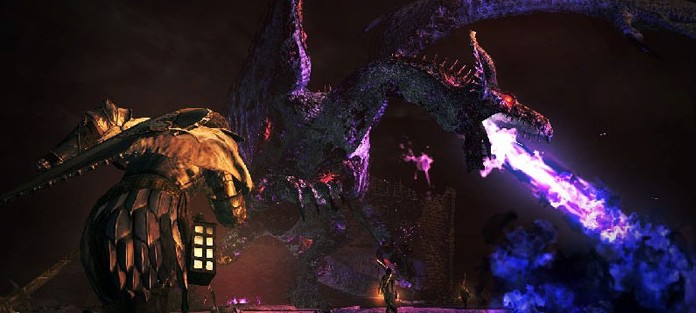
Dragon’s Dogma, a game releasing May 22, is doing something really cool with asynchronous events.  There’s an extremely difficult dragon boss called the “Ur-Dragon”.  Via Xbox Live or the Playstation Network, players combine their attacks, in their single-player game, on the Ur-Dragon until it is finally killed globally.  The player who deals the killing blow gets some extra rewards, but everyone who participates in their own single-player game gets rare items and all who participate get their name in some kind of hall of fame.

It won’t be long before players form guilds in their single-player experiences yet somehow work with other players.  Imagine a game like Skyrim or Kingdoms of Amalur: Reckoning where players might be able to come together at a guild hall in a city but when they leave the doors they’re back in their single-player World, or a global auction house available in the city of your single-player game.   There are lots of neat ideas, and asynchronous events are just the beginning of entirely new types of games.  It gets my imagination going to think about how other games or features from games can combine together.

You can watch the Ur-Dragon video after the jump. Continue reading “Single-player and Multiplayer Worlds Collide” »

The Next Evolution of D&D

We thought it was pretty cool when D&D went from being pen and paper only to being represented in video games.  It was even cooler when we saw D&D being played on a Microsoft Surface, but the details of how accessible to the public those inevitably expensive table-like-devices will be is still unknown.  What about tech and implementation more accessible, more affordable, and already available to the general public — what about a very similar idea to Skylanders?

What if you could have a figure of your character that fits in your pocket and contains all of the information pertaining to your D&D campaign?

  • Store your entire character sheet in your character figure.
  • Place your figure on the surface and it comes to life on the board/surface/tv/whatever tech is being used.
  • The D&D campaign could be streamed to any available device: iPad, iPhone, TV, Computer, Microsoft Surface, Consoles (especially the Wii), etc.

Dungeon Masters could program monsters and the campaigns ahead of time.  When a monster is encountered, the Dungeon Master pulls out the monster figure and places it on the board/portal device.  All calculations, abilities, loot, and every D&D detail is already accounted for because it is transferred to the game by the figure.  Battles can play out graphically on the streaming device and results of all actions are then transferred to the figure; details including up-to-the-minute health, spell usage, listen checks, modifiers, and etc.

New content, new areas, and anything the dungeon master wants to add to the campaign need only be set on the portal/surface and it is then available on the screen.  Players are given only what the dungeon master wants them to see and control is still in the hands of the players. Need to use a potion? Set the potion item on the portal, it scans in and heals you.  There are so many possibilities.

Watch the video below and just imagine it being D&D.

If this already exists, we implore you to link us so we can promptly go out and buy it.
